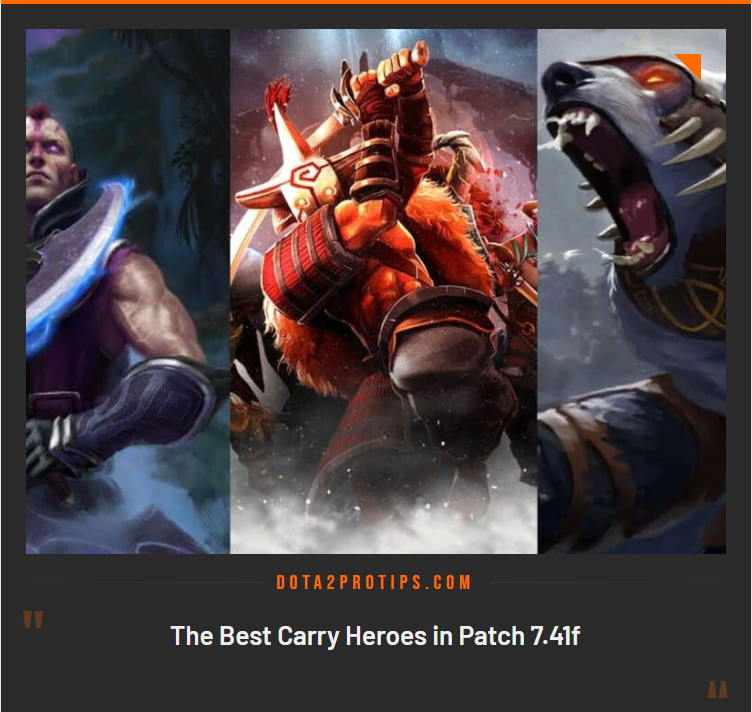
The Best Carry Heroes in Patch 7.41f
If you want to know which heroes are the best for the carry role, welcome to my world. For the ranking, I prioritized 7,000+ MMR role-filtered games and cross-checked them against PGL Wallachia Season 9, the completed Tier 1 event played entirely on 7.41f from September 19–27.
Quick Ranking
| Rank | Hero | High-MMR carry evidence | PGL Wallachia S9 evidence | Verdict |
|---|---|---|---|---|
| 1 | Sven | 51.5% win rate, 7,730 carry games | 22 picks, 15–7, 68.2% WR | Best overall combination of pub reliability and pro results |
| 2 | Lone Druid | 51.9% over 1,947 carry games; best lane advantage in the tracked pool | 20 picks, 13–7, plus 75 bans | The professional draft monster, but still a specialist hero |
| 3 | Kez | 45.5% WR over 2,432 carry games; 52.5% specialist WR over 476 games | 17 picks, 9–8; 26 bans | High-ceiling specialist who looks much better in expert hands than in the average pub |
| 4 | Phantom Lancer | 51.9% over 7,766 carry games; 61.6% WR after 50 minutes | 7 picks, 3–4 | Excellent pub carry, much more conditional in pro drafts |
| 5 | Ursa | 51.6% over 2,525 carry games after the 7.41f buff | 9 picks, 5–4 | Strong punish pick into melee and low-kite drafts |
Sven
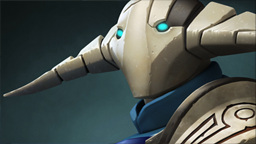
Sven is always eager to charge into a fight. He stuns grouped enemies as he wades into battle, and once he ignites his damage-boosting ultimate, a few swings of his massive sword are often more than enough to slay his foes.


Sven is the easiest number one on this list.
He is winning 51.5% of 7,730 high-MMR carry games, and PGL Wallachia gave us an even cleaner professional signal: 22 picks and a 15–7 record. His pub win rate also falls from 54.9% before 35 minutes to 47.4% after 50, which tells you exactly what the hero is supposed to do—farm quickly, hit his physical-damage timing, and end the game before every support owns three defensive items and a doctoral degree in kiting.
Lane and matchups
Sven is not picked to create the most beautiful safe lane in Dota. His lane is acceptable, and then Great Cleave turns every stacked camp into an apology from the opposing offlaner.
Current matchup data strongly favors him against Phantom Lancer, Meepo, Dark Seer, Naga Siren, and Lycan. That is not surprising: heroes relying on summons or illusions are basically volunteering additional cleave targets. His more uncomfortable games come against Templar Assassin, Troll Warlord, Lifestealer, Timbersaw, and Slardar, where burst mitigation, armor manipulation, or superior man-fighting can ruin the standard jump-and-delete plan.
The normal skill trend is one early point in Storm Hammer and Warcry before maxing Great Cleave. You do not need to manufacture lane kills. Secure the lane, stack whenever possible, and accelerate.
Build and timings
The current build remains straightforward:
Power Treads → Mask of Madness → Echo Sabre → Blink Dagger → BKB → Daedalus/Harpoon
Mask of Madness lost some lifesteal in 7.41f, while Daedalus became 100 gold more expensive, but the build still gives Sven the fastest route from “large man hitting neutrals” to “your support disappeared during the stun animation.” Satanic, Assault Cuirass, Swift Blink, and Aghanim's Shard are the usual extensions.
Draft Sven when your team has reliable vision or initiation and the enemy cannot repeatedly reset after your first jump. Avoid drafts where Sven is simultaneously expected to start fights, provide all the physical damage, and somehow chase four ranged heroes. He is a carry, not a public transportation service.
Pub verdict: Fast, reliable, and easy to convert into a real net-worth lead.
Pro verdict: Strongest carry in PGL and even in European Pro league.

Lone Druid
Battling alongside his powerful spirit bear, Lone Druid demolishes enemy forces and structures. Switching as needed between ranged and melee attacks with his transformation, should he have enough time to arm and strengthen both himself and his companion, there is little that can stop them.
Lone Druid is the hero professional teams feared most.
At PGL Wallachia, he was picked 20 times, won 13, and was banned 75 times. That is 95 combined picks and bans across 114 games. The pub picture is less absurd but still respectable at high MMR: 51.9% across 1,947 carry games, a +6.3% lane advantage, and a 61.5% win rate among tracked specialists. This is my data (from the meta page) and Dota2ProTracker.
Lane and matchups
The appeal is lane control. Lone Druid had the best minute-ten lane advantage among all carry heroes, and the hero’s two-body laning pattern lets him pressure while still maintaining reliable last hits.
Current matchup results are best against Anti-Mage, Dark Seer, Doom, Storm Spirit, and Ember Spirit. He struggles most against Underlord, Slardar, Batrider, Dawnbreaker, and Beastmaster—heroes capable of controlling space, killing the Bear, or forcing fights before Lone Druid comfortably distributes his economy.
The skill trend prioritizes Spirit Link and Entangle, followed by Savage Roar. The Bear is not simply a farming accessory anymore; coordinating Entangle stacks between both units is what turns favorable lanes into kills.
Build and timings
The current carry build revolves around:
Bear Power Treads → Maelstrom → Mjollnir → Bear Aghanim's Scepter, followed by Silver Edge, Diffusal Blade/Disperser, Skull Basher, or Assault Cuirass depending on the game. The high-MMR pro-build sample shows the Power Treads–Maelstrom–Mjollnir–Scepter core across 80 recent carry matches, with a 54% result.
Draft Lone Druid when your lineup can occupy territory, protect extended sieges, and punish opponents who give away the first 15 minutes. Avoid games with multiple Bear killers, heavy displacement, or wave clear that prevents your map pressure from becoming tower pressure.
Pub verdict: Strong, but you need to know how to play on the bear.
Pro verdict: The highest-priority specialist carry/flex of the patch.
Kez
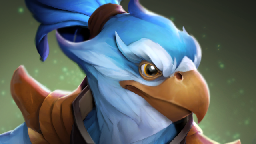
When it comes to strategy, Kez tends to wing it — he's able to swap on the fly between his katana and sai to slash, dash, swoop, and parry as the needs of the battlefield demand. But when he puts his mind to it, he can account for any eventuality, choosing the right tool to attack, escape or simply outwit his enemies with a little advance planning.
He is currently winning only 45.5% across 2,432 high-MMR carry games. But players who specialize in the hero are winning 52.5% across 476 matches, and Kez finished PGL Wallachia with 17 picks, nine wins, eight losses, and 26 bans. Wits, 423, Ame and watson all played him as a position-one option during the tournament.
Lane and matchups
His lane is better than the win rate suggests. Kez currently averages a small +0.7% net-worth advantage at minute ten, and the common carry build prioritizes Kazurai Katana before maxing Echo Slash, with early points in Grappling Claw and Raptor Dance.
Broad current matchup data favors Kez against Naga Siren, Beastmaster, Brewmaster, Meepo and Anti-Mage. The harder games include Tidehunter, Necrophos, Medusa, Clockwerk, Sniper and Muerta. These are general public-match numbers rather than carry-only matchup data, but the pattern makes sense: Kez likes units he can repeatedly hit and hates persistent control, forced positioning and cores that survive—or completely ignore—his first commitment.
Farming pattern and timings
Kez is not the classic carry who buys Battle Fury and disappears for twenty minutes. The current high-MMR build is much more aggressive:
Power Treads → Mage Slayer → Desolator → Aghanim's Scepter → BKB
Dota2ProTracker places the average timings at approximately 12 minutes for Mage Slayer, 18 for Desolator, 27 for Aghanim’s Scepter and 28 for BKB. Daedalus, Blink Dagger, Monkey King Bar, Butterfly, Satanic and Nullifier are the usual extensions, while Battle Fury and Manta Style remain situational rather than default purchases.
Draft fit
I want Kez when my team already has reliable initiation and the enemy has heroes he can continuously attack. He is particularly attractive against summon-heavy drafts and greedy cores that need time before they can defend themselves.
I do not want Kez as the only hero responsible for starting fights. He is much better entering second, after the obvious stuns and saves have been revealed. Force Staff, Hurricane Pike, Ghost Scepter, Glimmer Cape and instant disables all make his job considerably harder because his damage depends on maintaining contact and completing his sequence.
Pub verdict: Weak statistically, but dangerous for good specialists. Pro verdict: A really strong carry.
Phantom Lancer
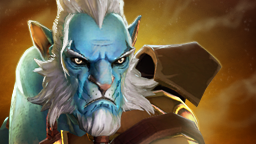
Phantom Lancer storms enemy forces with an endless supply of clones. Leading his illusory army, he can cut foes apart in a breathtaking flurry of attacks, send clones to push into enemy territory, or use his doppelgangers to mislead and elude foes if cornered.
Phantom Lancer is the clearest pub-versus-pro split on the list.
He is winning 51.9% across 7,766 high-MMR carry games, with a perfect 100/100 D2PT rating. More importantly, his win rate rises from 44.8% before 35 minutes to 57% between 35 and 50 and 61.6% after 50. If the game reaches the point where the enemy has to identify the real PL while also defending three lanes, good luck to them.
Lane and matchups
Spirit Lance is normally maxed first, with Doppelganger providing the defensive reset and Phantom Rush following for acceleration.
He is excellent against Viper, Wraith King, Chaos Knight, Clinkz, and Outworld Devourer. He struggles heavily against Underlord, Axe, Tidehunter, Leshrac, Sand King, Sven, and Earthshaker. The important question is not simply “does the enemy have AoE?” It is whether their AoE remains relevant after PL has Manta Style, Aghanim's Scepter, Heart of Tarrasque, and enough stats to survive the first spell cycle.
Build and timings
The standard progression is:
Power Treads → Yasha → Manta Style → Aghanim's Scepter → Orchid Malevolence/Bloodthorn or Aghanim's Shard, followed by Eye of Skadi, Butterfly, Heart of Tarrasque, or Abyssal Blade. Spirit Lance remains the lane and early-fight tool, while the scaling build turns PL into a map-control problem rather than a simple right-click hero.
Draft PL late, after confirming that the opposing lineup cannot clear illusions efficiently. Picking him into Sven because your spreadsheet says “PL has a 52% win rate” is a good way to become part of Sven’s win-rate statistic.
Pub verdict: One of the best late-game carries and fantastic against uncoordinated drafts. Pro verdict: powerful when protected, mediocre when exposed early.
Ursa
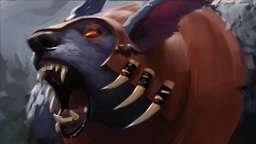
With each swipe of his claws, Ursa increases his target's vulnerability to his next attack. Capable of briefly increasing how swiftly he can strike, and able to slow down nearby prey, he quickly tears apart his enemies.
Ursa received the most obvious carry buff in 7.41f: Maul’s current-health damage increased from 1.25% to 1.75%. D2PT now has him at 51.6% across 2,525 carry games, with a positive lane advantage and a sharp increase in popularity across the patch window.
Lane and matchups
Ursa is strongest when the offlaner HAS to stand near the creep wave. Fury Swipes is still maxed first, with one early Earthshock and later points in Overpower. His current favorable matchups include Anti-Mage, Dark Seer, Bane, Tidehunter, and Pudge.
The ugly games are against Wraith King, Spectre, Weaver, Shadow Shaman, Phantom Lancer, Naga Siren, and Razor. These heroes either waste his first commitment, create too many targets, or make staying on one hero much harder than Ursa would like.
Build and timings
The mainstream farming build is:
Phase Boots → Battle Fury → Blink Dagger → Skull Basher → Black King Bar → Aghanim's Shard.
The Maul buff improves both lane trading and burst without changing how the hero wants to play. That is good design for Ursa players: no new mathematics, just a larger bear.
Draft him when the enemy has immobile cores and your team can provide vision or initiation. Avoid him when every opponent has a disengage button and your own lineup offers no way to start fights. Ursa without access to a target is just an angry melee creep with expensive inventory slots.
Pub verdict: Excellent punish pick, especially against greedy melee drafts. Pro verdict: **Viable and patch-relevant, but still dependent on draft geometry.**2
Final Verdict
Best overall carry: Sven—the strongest balance of high-MMR volume, win rate, farming speed, and Tier 1 performance.
Best raw MMR carry: Kez—53.1% in the role-filtered high-MMR sample, but you must play actively.
Best pro-style carry: Lone Druid—95 picks and bans at PGL says more than any public tier list.
Best late-game specialist: Phantom Lancer—terrifying after 35 minutes, provided you do not draft him into free illusion clear.
Best punish pick: Ursa—ideal when the enemy shows tanky or immobile cores without enough disengage.